If you live with POTS or another form of dysautonomia, you’ve probably had your heart rate and blood pressure checked more times than you can count. Those numbers matter. But for many people, they only tell part of the story.
At Lancaster Brain & Spine, we often meet patients who have done everything they were told: more fluids, more salt, compression garments, maybe medication. Some feel a little better. Many still feel dizzy, foggy, and wiped out when they stand. One piece of the puzzle that’s often overlooked is the vestibular system, the balance center in your inner ear and brain. Here’s why we test it, and why it can make such a difference.
Your Inner Ear Does More Than Balance
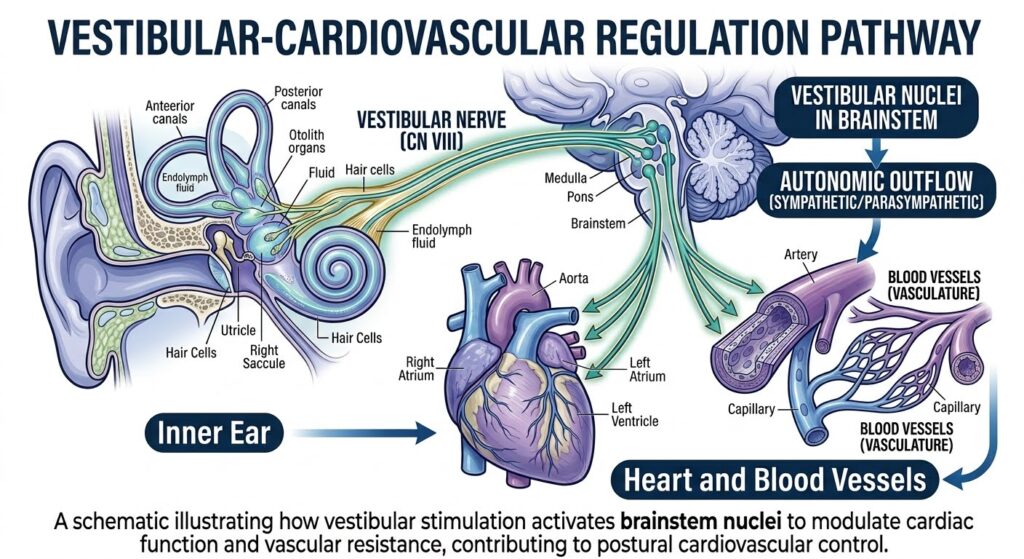
Most people think of the inner ear as the part of the body that keeps us from falling over. That’s true, but it does much more. Your vestibular system is your body’s reference point for where your head is and which way is up. Tiny sensors in the inner ear detect gravity and every tilt, turn, and change in position, and they report it to your brain all day long.
Your brain uses that information, along with signals from your eyes, joints, and muscles, to keep an up-to-date map of where every part of your body is in space. Think of it like the GPS on your phone, constantly recalculating as you move. Your brain can’t send help to the right places if it doesn’t know where those places are.
Standing Up Is a Team Effort
Think about what happens when you get out of bed in the morning. In about a second, your body has to do two big jobs at once:
- Turn on the right muscles in your legs, trunk, and back to hold you upright
- Adjust your blood vessels so blood doesn’t pool in your legs and keeps flowing up to your brain
Your vestibular system helps with both. Signals travel from the inner ear down pathways in the brainstem and spinal cord (the vestibulospinal pathways) that switch on the muscles that keep you upright. At the same moment, that same information about your position helps the brainstem tighten blood vessels and support your blood pressure. Researchers call this second piece the vestibulosympathetic reflex. It works alongside the pressure sensors in your neck and chest, and it’s one of the fastest ways your body gets ready for standing, often before your heart even has to react.
In other words, the same “you’re standing up now” message that tells your muscles to work also helps make sure your blood ends up where it’s needed.
What Happens When That Signal Is Off?
When the vestibular system and the brain aren’t communicating clearly, your brain’s map can be a little off, and the body may get the wrong message about what’s happening. The result may be a response that’s too strong, too weak, or poorly timed. For someone with POTS, that can look like:
- A racing heart when standing, as your heart works overtime to make up the difference
- Lightheadedness or feeling like you might pass out
- Nausea or a “seasick” feeling
- Brain fog and trouble concentrating
- Feeling unsteady, off-balance, or visually overwhelmed in busy places
Emerging research supports this connection. Recent studies have found that people with POTS often show differences in how their otolith organs respond compared with people without POTS, and that these differences are linked to how their heart rate and blood pressure behave. The research is still growing, but it points to the vestibular system as a meaningful part of the picture for many patients.
Why Standard Workups Often Miss It
A typical POTS evaluation focuses on the cardiovascular system: heart rate, blood pressure, and sometimes bloodwork. Those tests are important, and we use them too. But the vestibular system is rarely checked. If an inner ear or brain-processing issue is helping drive your symptoms, it can go unnoticed for years. That’s one reason so many people with dysautonomia feel like they’ve tried everything without real progress.
How We Evaluate the Vestibular System
Our approach is to look at the whole person, not just a single number. Alongside tilt table testing, our evaluation includes:
- Videonystagmography (VNG): a comfortable test where you wear special goggles so we can precisely record your eye movements. Because your eyes and inner ear are closely wired together, this gives us a clear look at how your vestibular system and brain are working.
- Eye movement assessment: how smoothly your eyes track, how accurately they jump between targets, and how steady your vision stays when your head moves. The areas of the brain and brainstem that control eye movements sit right next to the areas that help regulate your autonomic nervous system, so your eyes offer a valuable window into how those systems are functioning.
- Neck and cervical spine evaluation: your neck sends a constant stream of position information to the same brain centers that handle balance and autonomic control, so neck problems can add to the mix.
- A broader look at related factors, such as breathing patterns and conditions like EDS and MCAS that commonly overlap with POTS.
Putting these pieces together gives us a complete picture of what may be driving your symptoms, so your care plan can be built around you.
What Vestibular Treatment Can Look Like
When testing shows the vestibular system is part of the problem, treatment is gentle, specific, and paced to what your body can handle. Depending on your results, it may include:
- Targeted vestibular and eye movement exercises to help your brain process balance information more accurately
- Gradual position and tilt work to help your body build tolerance to being upright
- Neck and posture care when the cervical spine is contributing
- Home exercises you can do in short sessions on good days and hard days alike
Our goal is never to push you past your limits. We start where you are, watch how your body responds, and build from there. Many patients tell us that simply understanding why they feel the way they do is a huge relief.
You Deserve a Complete Evaluation
If you’ve been living with POTS or dysautonomia and still don’t have the answers you need, the vestibular system may be worth a closer look. You’re not imagining your symptoms, and you don’t have to keep guessing.
At Lancaster Brain & Spine in Lancaster, PA, we offer tilt table testing, VNG testing, and a full vestibular evaluation in one place. If you’d like to learn more, call us at 717-299-9600 or book a consultation through our website. We’d love to help you find your next step forward.
Further Reading
- Benarroch EE. Postural tachycardia syndrome: a heterogeneous and multifactorial disorder. Mayo Clinic Proceedings, 2012. https://pmc.ncbi.nlm.nih.gov/articles/PMC3547546/
- Kim KT, et al. Augmented ocular vestibular-evoked myogenic potentials in postural orthostatic tachycardia syndrome. Clinical Autonomic Research, 2023. https://pubmed.ncbi.nlm.nih.gov/37115468/
- Woo T, et al. Vestibulo-sympathetic interaction and otolith function in POTS. Clinical Autonomic Research, 2025. https://pubmed.ncbi.nlm.nih.gov/41045395/