Why Vestibular Testing Matters for POTS and Dysautonomia

If you live with POTS or another form of dysautonomia, you’ve probably had your heart rate and blood pressure checked more times than you can count. Those numbers matter. But for many people, they only tell part of the story.

At Lancaster Brain & Spine, we often meet patients who have done everything they were told: more fluids, more salt, compression garments, maybe medication. Some feel a little better. Many still feel dizzy, foggy, and wiped out when they stand. One piece of the puzzle that’s often overlooked is the vestibular system, the balance center in your inner ear and brain. Here’s why we test it, and why it can make such a difference.

Your Inner Ear Does More Than Balance

Most people think of the inner ear as the part of the body that keeps us from falling over. That’s true, but it does much more. Your vestibular system is your body’s reference point for where your head is and which way is up. Tiny sensors in the inner ear detect gravity and every tilt, turn, and change in position, and they report it to your brain all day long.

Your brain uses that information, along with signals from your eyes, joints, and muscles, to keep an up-to-date map of where every part of your body is in space. Think of it like the GPS on your phone, constantly recalculating as you move. Your brain can’t send help to the right places if it doesn’t know where those places are.

Standing Up Is a Team Effort

Think about what happens when you get out of bed in the morning. In about a second, your body has to do two big jobs at once:

  • Turn on the right muscles in your legs, trunk, and back to hold you upright
  • Adjust your blood vessels so blood doesn’t pool in your legs and keeps flowing up to your brain

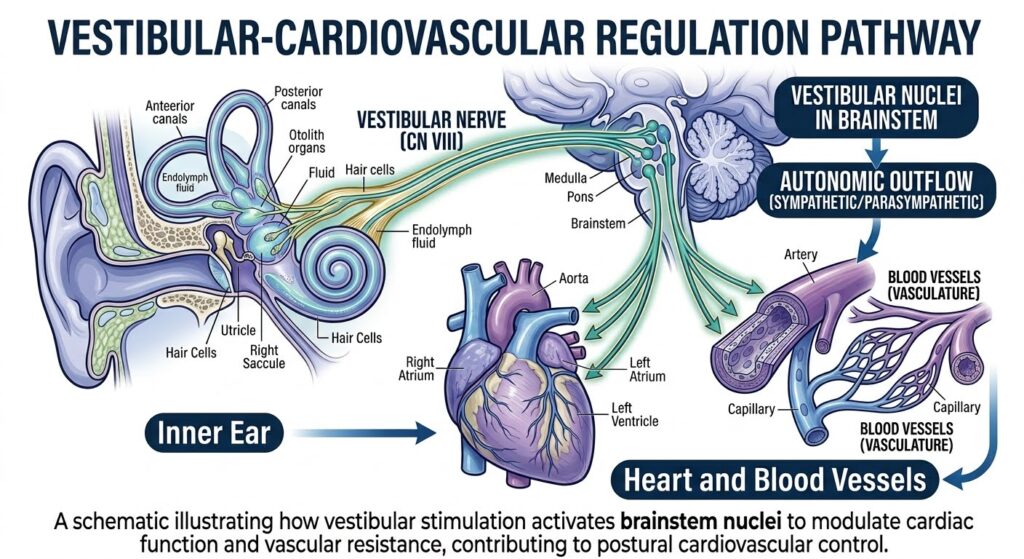
Your vestibular system helps with both. Signals travel from the inner ear down pathways in the brainstem and spinal cord (the vestibulospinal pathways) that switch on the muscles that keep you upright. At the same moment, that same information about your position helps the brainstem tighten blood vessels and support your blood pressure. Researchers call this second piece the vestibulosympathetic reflex. It works alongside the pressure sensors in your neck and chest, and it’s one of the fastest ways your body gets ready for standing, often before your heart even has to react.

In other words, the same “you’re standing up now” message that tells your muscles to work also helps make sure your blood ends up where it’s needed.

What Happens When That Signal Is Off?

When the vestibular system and the brain aren’t communicating clearly, your brain’s map can be a little off, and the body may get the wrong message about what’s happening. The result may be a response that’s too strong, too weak, or poorly timed. For someone with POTS, that can look like:

  • A racing heart when standing, as your heart works overtime to make up the difference
  • Lightheadedness or feeling like you might pass out
  • Nausea or a “seasick” feeling
  • Brain fog and trouble concentrating
  • Feeling unsteady, off-balance, or visually overwhelmed in busy places

Emerging research supports this connection. Recent studies have found that people with POTS often show differences in how their otolith organs respond compared with people without POTS, and that these differences are linked to how their heart rate and blood pressure behave. The research is still growing, but it points to the vestibular system as a meaningful part of the picture for many patients.

Why Standard Workups Often Miss It

A typical POTS evaluation focuses on the cardiovascular system: heart rate, blood pressure, and sometimes bloodwork. Those tests are important, and we use them too. But the vestibular system is rarely checked. If an inner ear or brain-processing issue is helping drive your symptoms, it can go unnoticed for years. That’s one reason so many people with dysautonomia feel like they’ve tried everything without real progress.

How We Evaluate the Vestibular System

Our approach is to look at the whole person, not just a single number. Alongside tilt table testing, our evaluation includes:

  • Videonystagmography (VNG): a comfortable test where you wear special goggles so we can precisely record your eye movements. Because your eyes and inner ear are closely wired together, this gives us a clear look at how your vestibular system and brain are working.
  • Eye movement assessment: how smoothly your eyes track, how accurately they jump between targets, and how steady your vision stays when your head moves. The areas of the brain and brainstem that control eye movements sit right next to the areas that help regulate your autonomic nervous system, so your eyes offer a valuable window into how those systems are functioning.
  • Neck and cervical spine evaluation: your neck sends a constant stream of position information to the same brain centers that handle balance and autonomic control, so neck problems can add to the mix.
  • A broader look at related factors, such as breathing patterns and conditions like EDS and MCAS that commonly overlap with POTS.

Putting these pieces together gives us a complete picture of what may be driving your symptoms, so your care plan can be built around you.

What Vestibular Treatment Can Look Like

When testing shows the vestibular system is part of the problem, treatment is gentle, specific, and paced to what your body can handle. Depending on your results, it may include:

  • Targeted vestibular and eye movement exercises to help your brain process balance information more accurately
  • Gradual position and tilt work to help your body build tolerance to being upright
  • Neck and posture care when the cervical spine is contributing
  • Home exercises you can do in short sessions on good days and hard days alike

Our goal is never to push you past your limits. We start where you are, watch how your body responds, and build from there. Many patients tell us that simply understanding why they feel the way they do is a huge relief.

You Deserve a Complete Evaluation

If you’ve been living with POTS or dysautonomia and still don’t have the answers you need, the vestibular system may be worth a closer look. You’re not imagining your symptoms, and you don’t have to keep guessing.

At Lancaster Brain & Spine in Lancaster, PA, we offer tilt table testing, VNG testing, and a full vestibular evaluation in one place. If you’d like to learn more, call us at 717-299-9600 or book a consultation through our website. We’d love to help you find your next step forward.

Further Reading

  • Benarroch EE. Postural tachycardia syndrome: a heterogeneous and multifactorial disorder. Mayo Clinic Proceedings, 2012. https://pmc.ncbi.nlm.nih.gov/articles/PMC3547546/
  • Kim KT, et al. Augmented ocular vestibular-evoked myogenic potentials in postural orthostatic tachycardia syndrome. Clinical Autonomic Research, 2023. https://pubmed.ncbi.nlm.nih.gov/37115468/
  • Woo T, et al. Vestibulo-sympathetic interaction and otolith function in POTS. Clinical Autonomic Research, 2025. https://pubmed.ncbi.nlm.nih.gov/41045395/

Add Your Heading Text Here

Understanding Postural Orthostatic Tachycardia Syndrome (POTS)

Postural Orthostatic Tachycardia Syndrome, commonly known as POTS, is a type of dysautonomia—a disorder affecting the autonomic nervous system. The autonomic nervous system is responsible for regulating many of the body’s automatic functions, such as heart rate, blood pressure, and digestion. When the autonomic nervous system is disrupted, it can lead to symptoms that impact daily life significantly, and POTS is one of the most prevalent forms of dysautonomia seen today.

What Is POTS?

POTS is characterized by an excessive increase in heart rate when moving from a lying down to a standing position. In healthy individuals, the body adjusts blood flow automatically to maintain a stable heart rate and blood pressure during changes in posture. However, in people with POTS, this regulation doesn’t function properly, causing blood to pool in the lower body and forcing the heart to work harder to circulate blood, leading to symptoms like rapid heartbeat and dizziness.

To be diagnosed with POTS, patients typically need to experience a heart rate increase of at least 30 beats per minute (40 bpm in adolescents) within 10 minutes of standing, without a corresponding drop in blood pressure. This condition primarily affects young adults, especially women, though it can occur at any age.

Symptoms of POTS

POTS can present with a wide range of symptoms, which can vary in severity. Common symptoms include:

    •    Lightheaded or dizzy upon standing
    •    Rapid heartbeat (tachycardia)
    •    Brain fog or difficulty concentrating
    •    Chronic fatigue
    •    Exercise intolerance
    •    Palpitations
    •    Headaches
    •    Nausea
    •    Tremors or shakiness

These symptoms can overlap with other health conditions, so it’s essential to seek a comprehensive evaluation to rule out other possibilities and confirm a POTS diagnosis.

Causes of POTS

The cause of POTS is not always clear, but several factors may contribute:

    •    Viral infections: Some patients report the onset of POTS after a viral illness.
    •    Genetic factors: POTS can run in families, suggesting a possible genetic component.
    •    Physical trauma or surgery: Certain physical traumas or surgeries can trigger POTS.
    •    Other health conditions: POTS is sometimes associated with other disorders, such as Ehlers-Danlos syndrome, Lyme disease, or autoimmune conditions.

Diagnosis of POTS

Diagnosing POTS usually involves assessing patient history, symptoms, and conducting specific tests. One common diagnostic tool is the tilt table test, where the patient lies on a table that tilts from horizontal to vertical to monitor heart rate and blood pressure changes. This test helps observe how the body responds to changes in position.

At Lancaster Brain & Spine, we use this and other diagnostic tools, including heart rate variability assessments, to thoroughly evaluate POTS and understand how each patient’s autonomic nervous system is functioning.

Treatment Options for POTS at Lancaster Brain & Spine

While there is currently no cure for POTS, various treatments can help manage symptoms and improve quality of life. Our clinic offers tailored treatments that address the underlying issues and help build tolerance to upright posture and physical activities. Here’s an overview of some of the treatment options we offer:

    1.    Tilt Table Therapy: This is a foundational treatment for POTS patients. By gradually exposing patients to upright positions in a controlled environment, tilt table therapy helps the body adapt to standing over time, reducing symptoms like dizziness and rapid heartbeat. We use this therapy in stages to ensure the body adjusts gradually and safely.
    2.    Vagal Nerve Stimulation: The vagus nerve plays a crucial role in regulating the autonomic nervous system. Through vagal nerve stimulation, we work to enhance the body’s parasympathetic response, which can help improve symptoms of POTS by calming the nervous system, reducing heart rate, and aiding in digestion.
    3.    Vestibular Therapy: Since POTS often involves symptoms of dizziness and imbalance, vestibular therapy can help improve stability and balance. Through exercises designed to stimulate the vestibular system, we can help retrain the body to maintain steadiness during movement and positional changes.
    4.    Eye Exercises: Eye movements are closely linked to balance and spatial orientation. By performing specific eye exercises, we target areas of the brain involved in these functions, helping to reduce dizziness and improve overall coordination.
    5.    Core Exercises: A strong core provides essential support for posture and balance, which is crucial for POTS patients. Core exercises can improve strength and stability, which helps to reduce strain on the heart and improve circulation when changing positions.
    6.    Cardiovascular Conditioning: While exercise can be challenging for those with POTS, cardiovascular conditioning under supervision can help improve tolerance to physical activity. We focus on recumbent or seated exercises initially to build up endurance safely before moving to more demanding exercises.

Tips for Managing POTS Symptoms at Home

Living with POTS requires an understanding of how to manage symptoms in day-to-day life. Here are some tips for making POTS more manageable:

    •    Stay Hydrated: Dehydration can worsen symptoms, so drinking plenty of water is essential. Electrolyte-rich drinks can also be beneficial.
    •    Increase Salt Intake: Sodium helps retain water in the body, which can improve blood volume and circulation. However, it’s important to consult with a healthcare provider before making significant changes to your salt intake.
    •    Eat Small, Frequent Meals: Large meals can divert blood to your digestive system, which may worsen POTS symptoms. Eating smaller meals throughout the day can help reduce this effect.
    •    Wear Compression Garments: Compression socks can help reduce blood pooling in the legs, supporting circulation and making it easier to stand for longer periods.
    •    Avoid Long Periods of Standing: If standing for long periods is unavoidable, try shifting your weight frequently or moving your legs to encourage blood flow.

Supporting Your Journey with POTS

POTS can be a challenging condition, but effective management is possible with the right support. At Lancaster Brain & Spine, we provide personalized care to help patients find relief from their symptoms. Our goal is to empower patients to understand their condition and offer treatments that fit their unique needs.

If you’re experiencing symptoms of POTS or suspect you may have it, consider reaching out to our team. We’re here to guide you through a comprehensive evaluation and develop a treatment plan designed specifically for you.